
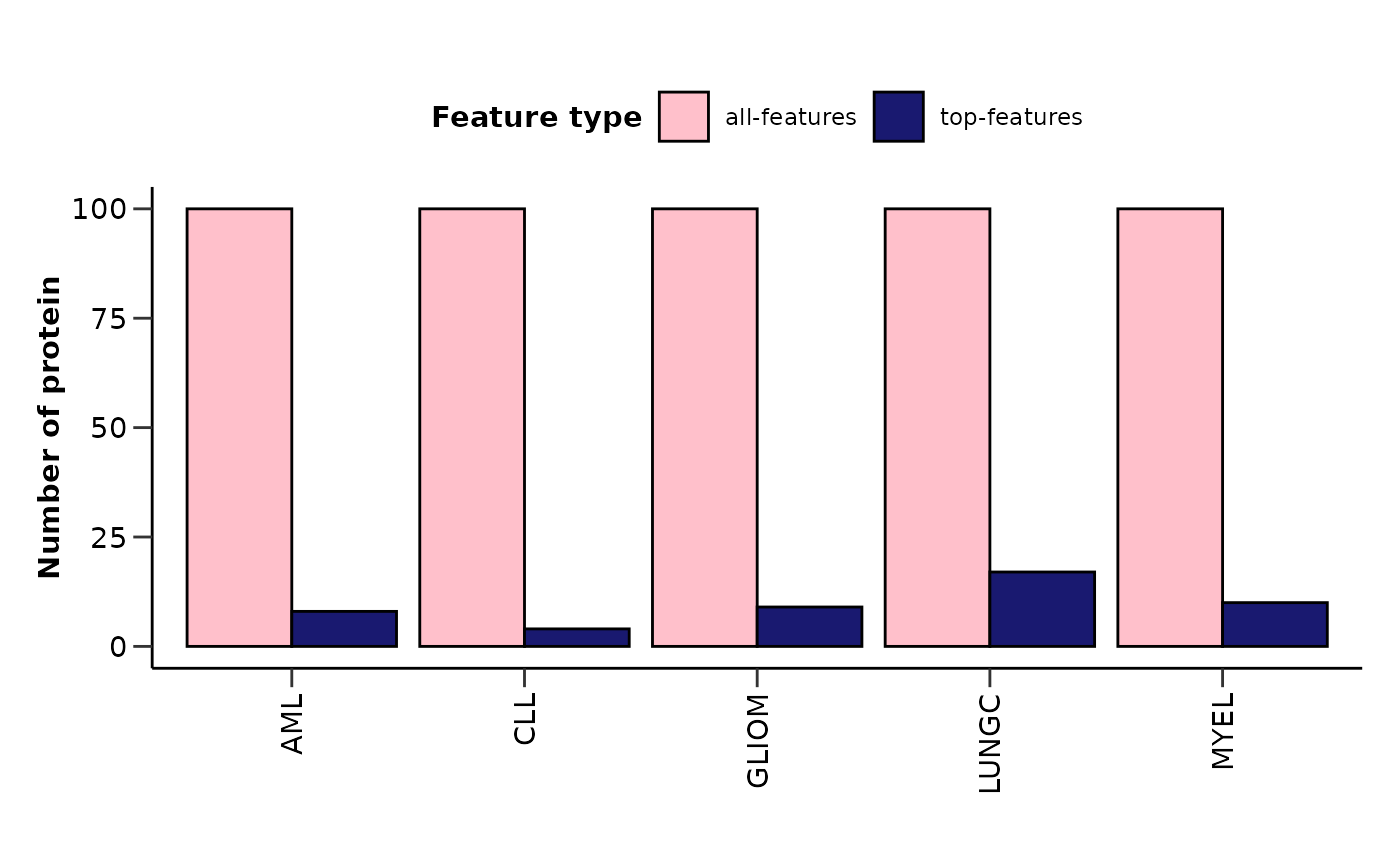
hd_plot_model_summary() plots the number of features and the number of top
features (feature importance > user defined threshold) for each disease in a barplot.
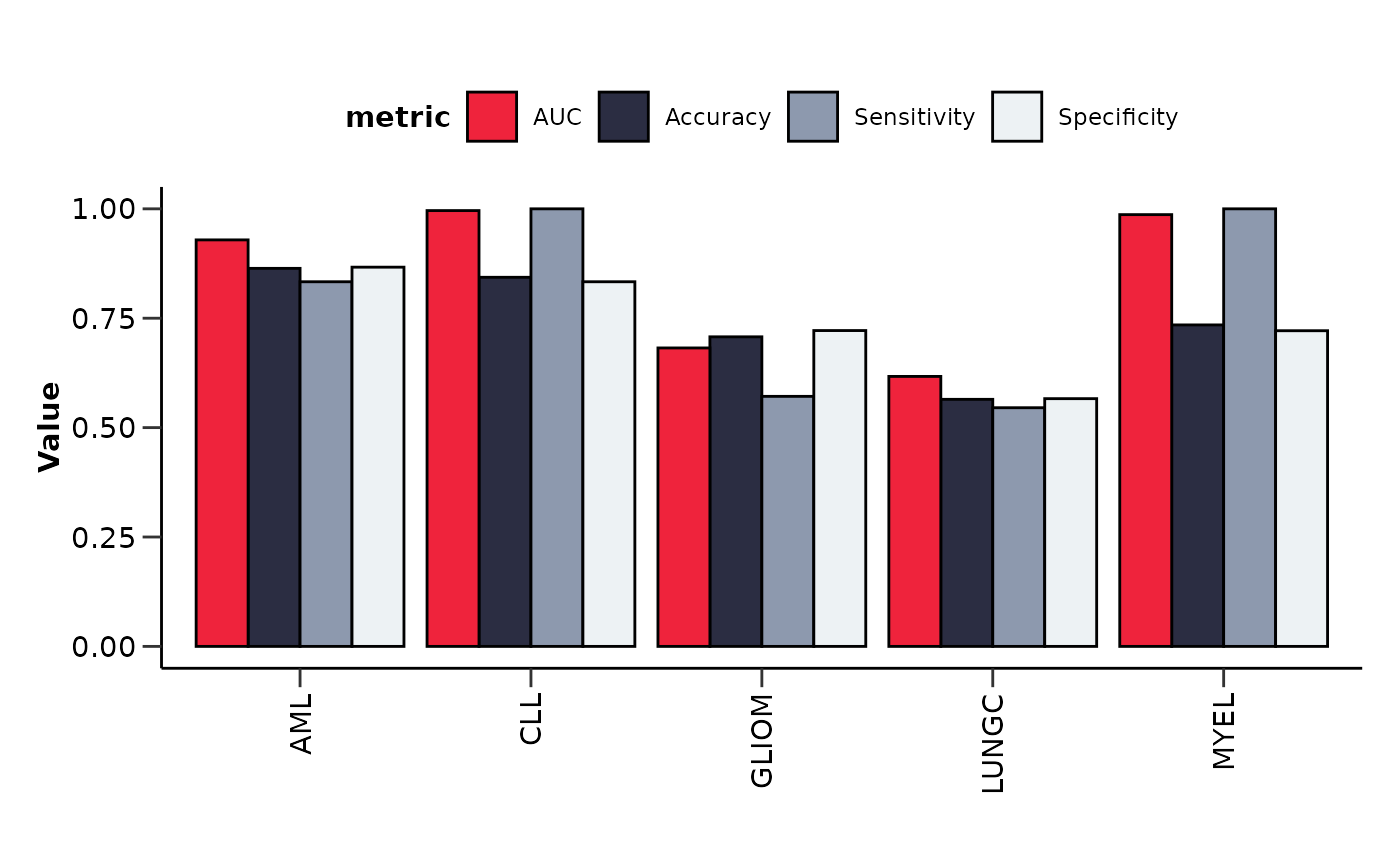
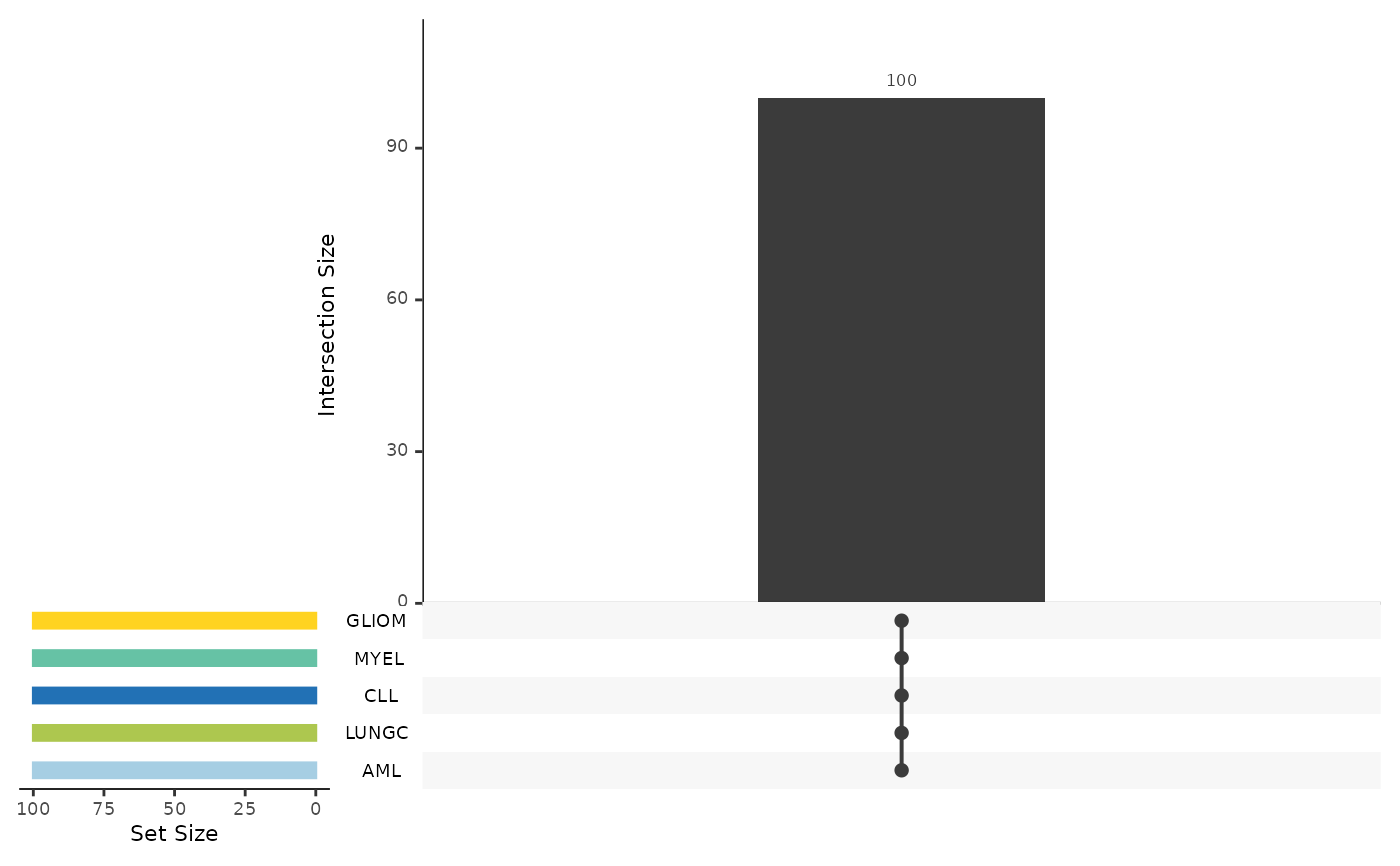
It also plots the upset plot of the top or all features, as well as a summary line plot
of the model performance metrics.
Usage
hd_plot_model_summary(
  model_results,
  importance = 0.5,
  class_palette = NULL,
  upset_top_features = FALSE
)
Arguments
- model_results
A list of binary classification model results. It should be a list of objects created by
hd_model_rreg(),hd_model_rf()orhd_model_lr()with the classes as names. See the examples for more details.- importance
The importance threshold to consider a feature as top. Default is 0.5.
- class_palette
The color palette for the classes. If it is a character, it should be one of the palettes from
hd_palettes(). Default is NULL.- upset_top_features
Whether to plot the upset plot for the top features or all features. Default is FALSE (all features).
Examples
# Initialize an HDAnalyzeR object with only a subset of the predictors
hd_object <- hd_initialize(example_data, example_metadata)
# Split the data into training and test sets
hd_split <- hd_split_data(hd_object, variable = "Disease")
#> Warning: Too little data to stratify.
#> • Resampling will be unstratified.
# Run the regularized regression model pipeline
model_results_aml <- hd_model_rreg(hd_split,
variable = "Disease",
case = "AML",
grid_size = 2,
cv_sets = 2,
verbose = FALSE)
#> The groups in the train set are balanced. If you do not want to balance the groups, set `balance_groups = FALSE`.
model_results_cll <- hd_model_rreg(hd_split,
variable = "Disease",
case = "CLL",
grid_size = 2,
cv_sets = 2,
verbose = FALSE)
#> The groups in the train set are balanced. If you do not want to balance the groups, set `balance_groups = FALSE`.
model_results_myel <- hd_model_rreg(hd_split,
variable = "Disease",
case = "MYEL",
grid_size = 2,
cv_sets = 2,
verbose = FALSE)
#> The groups in the train set are balanced. If you do not want to balance the groups, set `balance_groups = FALSE`.
model_results_lungc <- hd_model_rreg(hd_split,
variable = "Disease",
case = "LUNGC",
grid_size = 2,
cv_sets = 2,
verbose = FALSE)
#> The groups in the train set are balanced. If you do not want to balance the groups, set `balance_groups = FALSE`.
model_results_gliom <- hd_model_rreg(hd_split,
variable = "Disease",
case = "GLIOM",
grid_size = 2,
cv_sets = 2,
verbose = FALSE)
#> The groups in the train set are balanced. If you do not want to balance the groups, set `balance_groups = FALSE`.
res <- list("AML" = model_results_aml,
"LUNGC" = model_results_lungc,
"CLL" = model_results_cll,
"MYEL" = model_results_myel,
"GLIOM" = model_results_gliom)
# Plot summary visualizations
hd_plot_model_summary(res, class_palette = "cancers12")
#> $features_barplot
 #>
#> $metrics_barplot
#>
#> $metrics_barplot
 #>
#> $upset_plot_features
#>
#> $upset_plot_features
 #>
#> $features_df
#> # A tibble: 100 × 3
#> Shared_in `up/down` Feature
#> <chr> <chr> <fct>
#> 1 AML&LUNGC&CLL&MYEL&GLIOM NA ACAA1
#> 2 AML&LUNGC&CLL&MYEL&GLIOM NA ACE2
#> 3 AML&LUNGC&CLL&MYEL&GLIOM NA ACOX1
#> 4 AML&LUNGC&CLL&MYEL&GLIOM NA ACTN4
#> 5 AML&LUNGC&CLL&MYEL&GLIOM NA ADA2
#> 6 AML&LUNGC&CLL&MYEL&GLIOM NA ADAM23
#> 7 AML&LUNGC&CLL&MYEL&GLIOM NA ADAMTS15
#> 8 AML&LUNGC&CLL&MYEL&GLIOM NA ADAMTS8
#> 9 AML&LUNGC&CLL&MYEL&GLIOM NA ADCYAP1R1
#> 10 AML&LUNGC&CLL&MYEL&GLIOM NA ADGRE5
#> # ℹ 90 more rows
#>
#> $features_list
#> $features_list$`AML&LUNGC&CLL&MYEL&GLIOM`
#> [1] ANGPT1 ADGRG1 AMY2A ADA ADAMTS16 ADAM8 AMIGO2
#> [8] AHCY ANGPTL2 AMFR APEX1 ALCAM ADH4 ANPEP
#> [15] AK1 ATP6V1D ABL1 AARSD1 AXL ANKRD54 ALDH1A1
#> [22] APOH ACP6 ATXN10 AGRN ARHGAP1 ADGRE2 ACP5
#> [29] ATG4A ACAN APBB1IP ANXA5 APOM ARNT AMBN
#> [36] AMBP AGR3 APLP1 ANGPTL7 APP ANXA4 ATF2
#> [43] ATOX1 ADAMTS13 ANGPT2 ARTN ANXA11 ADGRG2 AOC3
#> [50] ACTA2 ADAM15 AMN ANG B4GALT1 ACY1 ANGPTL3
#> [57] ALDH3A1 AGRP ANXA10 ACAA1 ACE2 ACOX1 ACTN4
#> [64] ADA2 ADAM23 ADAMTS15 ADAMTS8 ADCYAP1R1 ADGRE5 ADM
#> [71] AGER AGR2 AGXT AHSP AIF1 AIFM1 AKR1B1
#> [78] AKR1C4 AKT1S1 AKT3 ALPP AMY2B ANGPTL1 ANGPTL4
#> [85] ANXA3 AOC1 AREG ARG1 ARHGAP25 ARHGEF12 ARID4B
#> [92] ARSA ARSB ART3 ATP5IF1 ATP5PO ATP6AP2 ATP6V1F
#> [99] AXIN1 AZU1
#> 100 Levels: ACAA1 ACE2 ACOX1 ACTN4 ADA2 ADAM23 ADAMTS15 ADAMTS8 ... ANGPT1
#>
#>
#>
#> $features_df
#> # A tibble: 100 × 3
#> Shared_in `up/down` Feature
#> <chr> <chr> <fct>
#> 1 AML&LUNGC&CLL&MYEL&GLIOM NA ACAA1
#> 2 AML&LUNGC&CLL&MYEL&GLIOM NA ACE2
#> 3 AML&LUNGC&CLL&MYEL&GLIOM NA ACOX1
#> 4 AML&LUNGC&CLL&MYEL&GLIOM NA ACTN4
#> 5 AML&LUNGC&CLL&MYEL&GLIOM NA ADA2
#> 6 AML&LUNGC&CLL&MYEL&GLIOM NA ADAM23
#> 7 AML&LUNGC&CLL&MYEL&GLIOM NA ADAMTS15
#> 8 AML&LUNGC&CLL&MYEL&GLIOM NA ADAMTS8
#> 9 AML&LUNGC&CLL&MYEL&GLIOM NA ADCYAP1R1
#> 10 AML&LUNGC&CLL&MYEL&GLIOM NA ADGRE5
#> # ℹ 90 more rows
#>
#> $features_list
#> $features_list$`AML&LUNGC&CLL&MYEL&GLIOM`
#> [1] ANGPT1 ADGRG1 AMY2A ADA ADAMTS16 ADAM8 AMIGO2
#> [8] AHCY ANGPTL2 AMFR APEX1 ALCAM ADH4 ANPEP
#> [15] AK1 ATP6V1D ABL1 AARSD1 AXL ANKRD54 ALDH1A1
#> [22] APOH ACP6 ATXN10 AGRN ARHGAP1 ADGRE2 ACP5
#> [29] ATG4A ACAN APBB1IP ANXA5 APOM ARNT AMBN
#> [36] AMBP AGR3 APLP1 ANGPTL7 APP ANXA4 ATF2
#> [43] ATOX1 ADAMTS13 ANGPT2 ARTN ANXA11 ADGRG2 AOC3
#> [50] ACTA2 ADAM15 AMN ANG B4GALT1 ACY1 ANGPTL3
#> [57] ALDH3A1 AGRP ANXA10 ACAA1 ACE2 ACOX1 ACTN4
#> [64] ADA2 ADAM23 ADAMTS15 ADAMTS8 ADCYAP1R1 ADGRE5 ADM
#> [71] AGER AGR2 AGXT AHSP AIF1 AIFM1 AKR1B1
#> [78] AKR1C4 AKT1S1 AKT3 ALPP AMY2B ANGPTL1 ANGPTL4
#> [85] ANXA3 AOC1 AREG ARG1 ARHGAP25 ARHGEF12 ARID4B
#> [92] ARSA ARSB ART3 ATP5IF1 ATP5PO ATP6AP2 ATP6V1F
#> [99] AXIN1 AZU1
#> 100 Levels: ACAA1 ACE2 ACOX1 ACTN4 ADA2 ADAM23 ADAMTS15 ADAMTS8 ... ANGPT1
#>
#>